
Why Raising a Child Between Cultures Means Explaining Everything
On the pavement, the compliments that sound like insults, and the words I had to build on the spot.
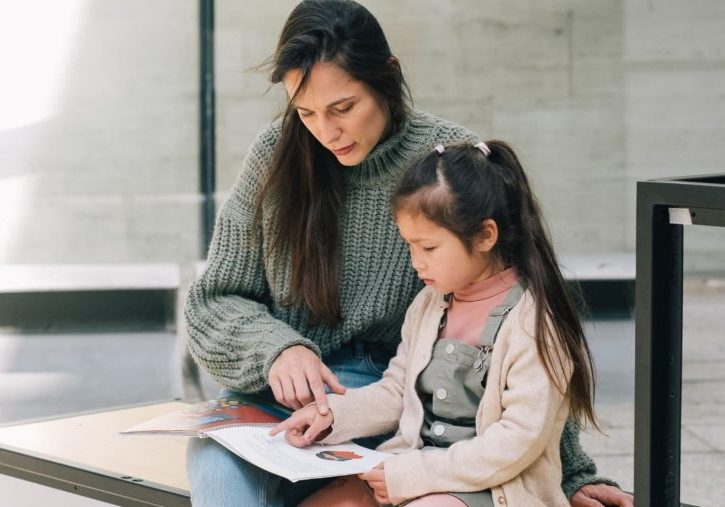
We were walking to school. People were coming from the opposite direction, and my daughter had to move almost entirely off the path for them to pass. If she had not, they would have walked straight into her.
I told her that personal space works differently here. That touching, bumping, brushing past someone on the street happens more often in Nepal than it would in a Western country, and that it does not mean what it would mean at home. Then I told her something else, something I had needed years to learn myself. You can just keep walking. You do not need to move aside every time. If the other person is not going to give way on their side of the path, it is fine if you bump into them. You need to take up your space here, or you will be stuck for a long time.
I said this in about thirty seconds, on an ordinary walk to school. No one had ever said it to me. I learned it slowly, through years of stepping aside, of feeling vaguely unsettled by the contact, of gradually working out that nothing rude was intended and nothing rude needed to be returned. My daughter received in half a minute what took me years to understand on my own.
Explaining without having been explained to
This is one of the stranger positions a parent raising a child between cultures finds herself in. You are constantly constructing explanations for things that nobody ever constructed for you. There was no manual handed to you when you arrived, no conversation where someone sat you down and explained how space, attention, or speech worked differently here. You learned through friction, through small confusions, through enough repeated experience that a pattern eventually became visible.
And now you are the one who has to turn that hard-won pattern into something simple enough to hand to a child standing beside you on a Tuesday morning.
Two more moments, on the same theme
The pavement is not the only place this happens.
In Nepal, people will often comment on a person's body in a way that would be considered deeply inappropriate in the West. If someone tells a girl she has gotten fat, it is not meant as an insult. It is closer to a compliment, an observation that she is eating well, that she is healthy, that things are going well for her. In the West, the same sentence would be received as a wound. I had to explain this distinction to my daughter directly, and then add something practical alongside it: if she does not like hearing it, she does not need to engage with it. She can simply let it go.
There was also the matter of greeting. When people say namaste to her on the street, I told her she can always say it back. That it is polite, and there is no risk in returning it, even to a stranger. This sounds like a small thing. But for a child moving between a culture where greeting strangers is unusual and one where it is expected and welcomed, even this needed to be said out loud, because it was not obvious from either of her worlds on its own.
Each of these moments is small on its own. None of them is dramatic. But they share a structure, and that structure is worth naming. In each case, I am teaching her to read a signal correctly, what a comment means, what a greeting requires, what physical space actually signals here, so that she does not carry the confusion I carried for years before I worked it out myself. This is interpretive confidence, built and handed over in real time, rather than earned slowly through trial and error the way I had to earn it.
The strange gift of explaining things badly understood
There is something almost moving about being able to compress years of confusion into thirty seconds for someone you love. My daughter will likely never feel the disorientation I felt on those early walks, the slight flinch of unexpected contact, the half-formed question of whether something rude had just happened. She will simply know, because I told her, because I had already done the work of turning confusion into something usable.
But there is also something slightly disorienting about the explaining itself. I am teaching her rules that were never taught to me, in a country that is fully hers in a way it will never quite be fully mine. She is growing up inside the logic I had to learn from the outside. In some sense, she will understand this place more natively than I ever will, even though I am the one handing her the words for it.
That reversal, the parent explaining a world she once had to decode alone, to a child for whom that world may become simply normal, is one of the quieter and more particular experiences of raising children between cultures.
What this is actually teaching her
Underneath the specific lessons, the pavement, the comments about her body, the greetings, there is a larger thing being passed on, even if I never say it directly. I am teaching her that different places run on different rules, that none of those rules are inherently right or wrong, and that the skill worth having is not memorising every rule in advance but learning to read a situation and respond without losing her footing. That skill is close to what this platform has called grounded identity: not a fixed answer for every culture she will move through, but a steadiness that travels with her regardless of which rules happen to apply where she is standing.
I did not have anyone explain that to me directly either. I am only realising it now, in the act of trying to explain something much smaller to her.
If you find yourself doing this too
If you are raising a child between cultures and find yourself constantly building explanations for things you never had explained to you, you are not improvising badly. You are doing something genuinely difficult, translating years of your own quiet confusion into something fast, clear, and useful for someone you love. The free guide Why Women Living Between Cultures Start Doubting Themselves touches on this same experience, the sense of having to build your own map while also handing pieces of it to someone else, and why that double task is harder than it looks from the outside.
You learned it the slow way so she would not have to. That is not a small thing to have given her.